
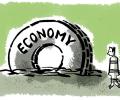
Moody's Investors Service on Friday projected India's growth at zero per cent for the current fiscal and said the negative outlook on sovereign rating reflects increasing risks that GDP growth will remain significantly lower than in the past. The outlook also partly shows weaker policy effectiveness to address economic and institutional issues, it noted in the update to its November 2019 rating forecast.

India will grow at around 8 per cent this year and next, but the principal risk to this projection stems from the demand-led inflation that "would occur if the total Pay Commission award for government employees were to be paid out immediately," the Paris-based Organisation for Economic Cooperation has warned.Besides, "quick action to write off small farmers' debt would also add substantially to demand," the OECD indicated in its latest Economic Outlook.

Operating margins have been the primary driver of corporate earnings in India in recent quarters, despite revenue growth suffering from weak consumer demand. Companies across sectors have reported a sharp improvement in earnings before interest, tax, depreciation, and amortisation (Ebitda) margins over the past two years, benefiting from lower commodity and energy prices. Higher margins more than compensated for slower revenue growth, resulting in double-digit growth in net profit for five consecutive quarters.

Asian economies have been very strong in their stimulus from both monetary and fiscal sources.

The International Monetary Fund on Thursday retained its projection for Indian economic growth at 5.4 per cent in 2009, implying a slower growth in the second half of this calendar year.
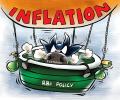
"We have to stand in readiness to go beyond keeping Arjuna's eye to deploying policy instruments, if necessary" to contain inflation, said Reserve Bank Governor Shaktikanta Das on Thursday. Headline consumer price index-based inflation projection for the second quarter of 2023-24 has been revised up substantially, primarily due to the price shock from vegetables, at 6.2 per cent by the RBI form 5.2 per cent estimated in June. Unveiling the bi-monthly monetary policy, Governor Das said the moderation in headline inflation to 4.6 per cent in the first quarter of 2023-24 was in line with the projections set out in the June MPC meeting.

'India is an equity market with a breadth and depth of companies to invest in.'

Kotak Bank was the top loser in the Sensex pack, cracking around 6 per cent, followed by Hero MotoCorp, Bajaj Finance, Maruti and HDFC twins. On the other hand, HUL, HCL Tech, ITC and Nestle India were among the gainers.

It was August 2007. Tata Steel was turning 100. Jamshedpur, its hometown, had an air of celebration. The line-up for the special event included the launch of Air Deccan's commercial flight connecting Kolkata and Jamshedpur, and release of Russi Lala's new book, Romance of Tata Steel. There was also the screening of The Spirit of Steel, a 20-minute documentary directed by Zafar Hai showcasing Tata Steel's legacy, and a corporate anthem penned by Javed Akhtar and composed by Shankar, Ehsaan and Loy.

Standard and Poor's raised the outlook for India's "BBB-minus" rating back to "stable" from 'negative,' saying Prime Minister Narendra Modi government's 'strong' mandate would allow it to implement fiscal and economic reforms.

The new Samvat 2080 is viewed as a year of hope for industrial and precious metals. A key reason is the expectation of US interest rates peaking, followed by a reduction in the coming months. Regarding crude oil, its trajectory depends more on how the situation unfolds in West Asia.

Have the markets already played out their dynamics before the economy has even properly taken off? Are we now destined for a period of mediocre returns despite a strong economy? asks Akash Prakash.

Many CEOs said they plan to give special leave to women employees so as to encourage their participation in the workforce.

India's real GDP growth will decline marginally to 6.3 per cent in 2024 from the 6.4 per cent estimated for 2023, an American brokerage firm said on Monday. The next calendar year will be of two halves, wherein the government spending before the upcoming General Elections will be the key driver for growth, while after the elections, it will be the re-acceleration in investment growth, especially from the private sector, Goldman Sachs said in a report. From a fiscal year perspective, the brokerage said it expects growth to accelerate to 6.5 per cent for FY25 from the 6.2 per cent it has projected for the ongoing FY24, it added.
It is striking how quickly the over-hyped optimism over the evolving India economic story has given way to a reality check in general and pessimism over the economic outlook in particular. Capital inflows into India were attracted by the increasing domestic and global acknowledgement of the favourable structural economic shifts.

Indian economy is expected to clock an average growth rate of 6.7 per cent till 2026-27 fiscal driven by domestic consumption, S&P Global Ratings senior Economist (Asia Pacific) Vishrut Rana said on Wednesday. He said the economic growth in the current fiscal is expected to come in around 6 per cent, lower than 7.2 per cent clocked in 2022-23. "We are seeing some headwinds from the trade side which is affecting activity and that is one of the factors that is affecting growth this year," Rana said at a webinar.
India's economic growth is likely to shrink by 1.25 per cent to 7.9 per cent this fiscal, mainly on account of tight monetary conditions and continued pressure on inflation, the International Monetary Fund said on Friday. The IMF report also warned that investment would be more affected than consumption on account of the tight monetary conditions and fall in global economy following US sub-prime crisis. Compared to China, India has little fiscal space to keep up the growth.
Bank stability and safety are still high on corporate and investor agendas, says a Global Finance study.

Exports dropped 3.1 per cent in June from a year earlier, the first decline since January last year while imports went down 0.7 per cent, General Administration of Customs said on Wednesday.
Survey likely to be tabled in July by the new government.

The Indian economy, severely hit by the coronavirus pandemic, is projected to contract by a massive 10.3 per cent this year, the International Monetary Fund said on Tuesday. However, India is likely to bounce back with an impressive 8.8 per cent growth rate in 2021, thus regaining the position of the fastest growing emerging economy, surpassing China's projected growth rate of 8.2 per cent, the IMF said in its latest 'World Economic Outlook' report.

Gita Gopinath, the IMF's Indian-American chief economist has been promoted as its First Deputy Managing Director recognising her exceptional intellectual leadership in helping the global economy and the Fund to navigate the "twists and turns" of the "worst economic crisis of our lives". Gopinath would replace Geoffrey Okamoto who plans to leave the International Monetary Fund early next year, Kristalina Georgieva, IMF's managing director announced on Thursday. Gopinath, who was scheduled to return to her academic position at Harvard University in January 2022, has decided to stay, she said. Gopinath, 49, has served as the first female chief economist of the Washington-based global lender for three years.
Asian Development Bank on Thursday pegged India's economic growth at 7.4 per cent for 2004 and said high growth is likely to be sustained in medium term.

According to latest data, crops have been sown in around 72.13 million hectares, which is 8.90 per cent less than the same period last year.

Silver, which is currently trading at Rs 68,453 per kilogram, has appreciated 21.7 per cent over the past three months. Investors, however, shouldn't get carried away by its recent performance and put their money in it. Instead, they should evaluate its pros and cons and then take a considered decision based on their risk appetite.

Substantial gains can still be made with good policies and initiatives.
In 2007-08, the farm sector growth stood at 4.5 per cent, while it was 3.8 per cent and 5.9 per cent in 2006-07 and 2005-06, respectively. The report, which was released on Wednesday by outgoing council Chairman C Rangarajan, said the lower growth projection is in part due to the base effect of very high growth in 2007-08 and the weak South-West monsoon over peninsular, central and western India in July.
The International Monetary Fund on Thursday asked India to "very carefully" look at the much-touted Special Economic Zones, saying the giveaways and tax sops to the zones could divert industrial activity from the rest of the country.

The rating outlook change is relevant now, as the US Federal Reserve is set to end its monthly bond-buying programme in October.
The Reserve Bank of India said that the ongoing momentum in economic growth is likely to remain robust in the rest of 2006-07 along with expectation of lower increase in selling prices, exports and imports.

Order inflows during the quarter-ended September declined 31.5 per cent compared to the level a year ago. Companies are still not committing fresh capital expansion.

Singh emphasised that the Indo-Pacific is no more a maritime construct, but a full-fledged geo-strategic issue, and that the region is facing "a complex web" of security challenges, including boundary disputes and piracy.

A lot depends upon the crucial decision-making skills of the management. If you have any doubts about the management then you always have the choice of selling your shares or not buying stocks of those companies at all.
 © 2026 Rediff.com - Advertise with us - Disclaimer - Privacy Policy - Sitemap - Feedback - About us - Terms of use - Grievances